5 min read
SAP to AI: HANA Co-Inventor's Next Bet on AI
How my thirty years of architecting the foundations of SAP set the stage for building Nova Intelligence.

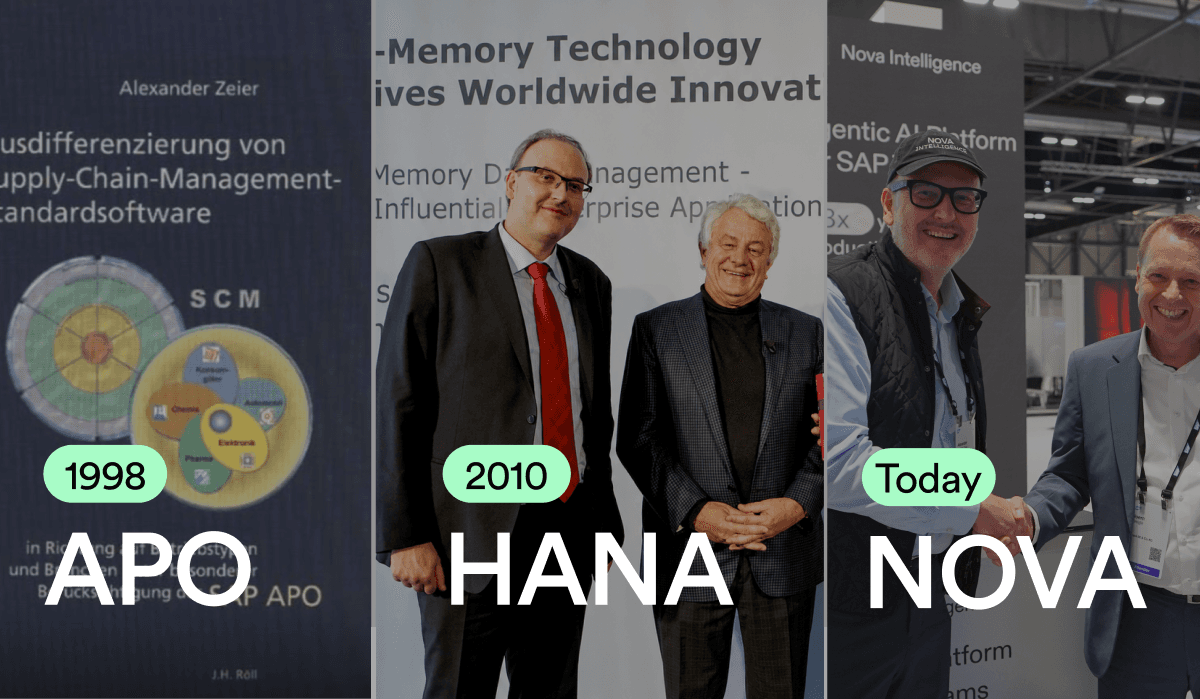
How my thirty years of architecting the foundations of SAP set the stage for building Nova Intelligence
I have worked on SAP systems since 1992, when R/3 was brand new — and I have spent that career as an architect: at SAP, at Accenture as Master Technology Architect, and today as Chief Scientist of Nova Intelligence. If that career taught me one thing, it is this: every platform stands or falls with its architecture. I helped build two architectures that changed how enterprises run — APO and HANA. Today I am building the third, and I am convinced it is the most important one, because it makes Enterprise AI real.

APO: Enterprise Planning
The Advanced Planner and Optimizer (APO) was my first product — SAP's solution for supply chain management. I started working on it in 1998, first in my doctoral research, then as SAP's Product Manager for SCM. APO planned and optimized beyond company boundaries — connecting suppliers, production, and customers across the entire supply chain — powered by liveCache, SAP's first in-memory database, which held the planning data in main memory instead of on slow disks. Shaped over seven years, it grew from launch to world market leader.
HANA: Enterprise Data
HANA was the second — and the deepest. In April 2006, as deputy to Hasso Plattner — SAP's co-founder and then chairman of the supervisory board — I started the HANA project and led it until 2012, when the “New Architecture” was successfully established in the market. From the very beginning, we grounded it in reality: we analyzed the workloads of more than 60 SAP customers to derive the requirements for the system of the future — and on that basis invented the “New Architecture”, as Hasso and I had called the project from day one: all enterprise data in main memory, exploiting modern multi-core processors, and, for the first time, transactions and analytics in one and the same database. The goal was radical: sub-second answers. Business processes and analyses that used to run overnight — sometimes for days — now finished in seconds or less. That leap is what made the “New Architecture” matter for the business: SAP had become a real-time data platform. Eight granted patents document this invention — the foundation of my role as co-inventor of SAP HANA. It became SAP's most disruptive breakthrough in 25 years — and the foundation of S/4HANA and SAP's core applications today. The book Hasso and I wrote on the HANA architecture, "In-Memory Data Management", became the reference work for the technology — with a foreword by John L. Hennessy and David A. Patterson, the two Turing Award winners who shaped modern computer architecture. Hennessy, then President of Stanford, chairs the board of Alphabet today. At the book's launch at CeBIT 2011, then the world's largest technology fair, I had the honor of personally handing a signed copy to Chancellor Angela Merkel.
Every architecture came with its reference works: nine books — from my doctoral thesis on APO and the SCM reference books in Springer's SAP series, which SAP itself distributed to its customers, to the two In-Memory Data Management books with Hasso Plattner — the standard works that laid out the HANA architecture, published in multiple editions and languages — alongside more than 100 scientific publications and ten patents. And the research continues: as Honorary Professor of Computer Science (AI & Intelligent Enterprise Systems) at the University of Magdeburg — home of the world's largest academic SAP competence center — and after academic stations as Visiting Professor at MIT and Visiting Scholar at Stanford, my passion for the research frontier has only accelerated: AI is the most profound shift I have seen in thirty years.
Nova: Enterprise AI
Which brings me to today. Everyone can see what AI models are capable of — and everyone who uses them in a company feels the same frustration: the models are brilliant, but they know nothing about your enterprise. Not your processes, not your custom-built logic, not your integrations, not the decisions of the past twenty years or the reasoning behind them. That is the difference between AI and Enterprise AI: Enterprise AI knows your enterprise — and it does the work in it.
This is exactly what we built Nova Intelligence for — for me, the most exciting product I've worked on. Nova is an independent agentic AI platform and official SAP partner: AI agents that work alongside enterprise teams across the complete lifecycle of their systems — understanding them, designing, building, and operating them. The agents are autonomous: they take work through to done. What makes that possible is the Enterprise Knowledge Core — the shared context of the enterprise, built up individually for every customer. Every agent draws on it, every project enriches it. Knowledge is what lets an agent act correctly inside a live enterprise system; execution is what makes the knowledge worth having.
And this knowledge core has a property that no earlier architecture had. Data sits still. Software depreciates. Enterprise knowledge compounds: every project makes the core richer, every decision becomes reusable, and every transformation starts smarter, faster, and cheaper than the one before. APO shared the planning model. HANA shared the data. Nova shares the intelligence — and puts it to work.
For me, this closes a circle. The HANA architecture I co-invented with Hasso Plattner set off the largest modernization wave in SAP's history: core systems, decades of custom code, and entire landscapes are now moving to the new foundation — S/4HANA and the cloud. I know this wave from both sides: I co-architected the platform it leads to — and for eleven years at Accenture, as Managing Director and Global CTO of its SAP Business Group, I drove the transformation in practice, across hundreds of global SAP and S/4HANA implementations. That is exactly the knowledge we built into Nova — executing this modernization with the latest AI technology, high-performance and scalable. And modernization is only the beginning: the same platform powers the optimization and the daily operation of the system — AI at scale, every day.

Enterprise AI must execute — and it cannot stop at system boundaries
Nova is already in production at some of the world's largest and most complex SAP environments — Festo achieves 5x productivity, KION resolves issues 8x faster, and ZEISS — whose optics power ASML's machines, and with them the world's AI chips — drives both greenfield and brownfield transformations with Nova: two paths, one platform, one growing knowledge core.
Because knowing is only half the job. Advice, drafts and recommendations don't transform an enterprise; completed work does. That is what sets Nova apart: our agents don't stop at suggesting — they drive the work through to done. They design process changes and support their implementation all the way into the SAP system. They turn business requirements into solution designs and ready-to-apply configuration. They build code, generate and run the tests. They investigate production incidents down to the root cause and fix them. They audit custom code for security vulnerabilities — from routine to deeply hidden — and have found them at customers within minutes, not weeks: an argument every compliance team understands. And across all of this, they radically shorten the business-to-IT cycle — from business requirement to running solution — to a degree our customers have measured for themselves. They do this for the entire team — business process owners, functional consultants, developers, and operations — with enterprise-grade controls and approvals where they matter, always focused on business value.
And enterprise knowledge does not live in one system, so Enterprise AI cannot stop at system boundaries. Ours doesn't. Nova's agents already work across the SAP toolchain and into the surrounding business systems — reading from them, acting in them, and carrying the context between them, because that is how the work actually gets done in our customers' landscapes. That is also where we keep extending: further along the end-to-end business processes these systems power.
Enterprise Planning empowered enterprises to plan as one — that was APO.
Enterprise Data empowered them to run on one foundation — that was HANA.
Enterprise AI empowers them to learn as one — and to turn what they know into finished work. That is Nova.
Three architectures. One architect's conviction: enterprise knowledge should compound, and it should get the work done — so that every transformation makes the next one smarter.
What a compounding knowledge core delivers in practice can be seen at www.novaintelligence.com— always with the latest use cases and customer results.